- Home
- Government
- Divisions
- Energy and Environment
- Department of Climate & Energy
- Community Electric Vehicle Readiness Plan
- Myths, FAQs, and Info About Electric Vehicles
Myths, FAQs, and Info About Electric Vehicles
Do you have a question about electric vehicles that isn't addressed here? Send comments to sustainability@FrederickCountyMD.gov or follow our community conversation at www.Facebook.com/SustainableFCMD.
- MYTH: Electric vehicles are worse for the environment than regular cars!
- FACT: EVs produce no emissions- that means no tailpipes producing air pollution or greenhouse gases (GHG)! That's good for human AND environmental health. However, generating the electricity used to charge EVs may create GHG emissions. The amount varies widely based on how local power is generated. Hooking up to renewable resources like wind or solar doesn't generate GHG emissions, but electricity fueled by coal or natural gas does. Even accounting for these electricity emissions, research shows that EVs are typically responsible for lower levels of GHG emissions than gas-powered vehicles. The EPA and U.S. Department of Energy's Beyond Tailpipe Emissions Calculator can help you estimate the GHG emissions associated with charging and driving an EV or PHEV right where you live.
- MYTH: EV batteries will wreck the environment.
- FACT: There are sustainability concerns associated with EV manufacturing. EV construction requires approximately six times more minerals than gas-powered vehicles. However, the total lifetime GHG emissions associated with EVs are lower than those from gas-powered vehicles, even when accounting for battery manufacturing. This is because EVs have zero tailpipe emissions and are typically responsible for significantly fewer GHG emissions during their operational lifetime. Technology to support EV battery recycling is also rapidly emerging.
- MYTH: The U.S. power grid cannot accommodate EVs.
- FACT: The increasing number of EVS on the road will lead to increased electricity demand. How that impacts the power grid will depend on several factors, including the time of day when vehicles are charged. EVs can be charged at off-peak times, such as overnight, when rates are often cheaper. Further down the road, when renewable enery sources make up a larger part of our energy mix, switching to more daytime charging (when some renewables like solar generate energy) with some energy storage capability should allow the grid to handle increases in EV charging need.
- MYTH: My electricity bill will increase significantly if I buy an EV.
- FACT: While EV drivers typically use more household electricity, the savings on gasoline will cover it. (It costs less to charge an EV than to pay for a fuel tank of gas.) A 2020 Consumer Reports study found that EV drivers spend approximately 60% less on “fuel” costs than the average gas-powered vehicle in the same class. Fuel costs depend on factors such as the efficiency of the EV, regional electricity costs, and driving and charging patterns.
- MYTH: EVs don’t have enough range to handle daily travel demands.
- FACT: EVs have sufficient range to cover a typical household’s daily travel, which is approximately 50 miles on average per day. The majority of households (roughly 85%) travel under 100 miles on a typical day. Most EV models go above 200 miles on a fully-charged battery, with nearly all new models traveling more than 100 miles on a single charge. While not suited for every situation, EVs can work for many households, especially two-car families.
- MYTH: There is nowhere to charge an EV near me.
- FACT: The majority of EV drivers charge their cars at home. Many people can meet their daily driving needs by plugging in only at home. And when there is a need to charge while on the road, access to public EV charging will increase significantly in the coming years as a result of government initiatives put in place as part of the Bipartisan Infrastructure Law, including an investment of up to $7.5 billion to build out a national network of electric vehicle chargers along highways, and in communities and neighborhoods.
- MYTH: EVs are too expensive.
- FACT: Although the upfront costs of EVs are typically higher than comparable gas-powered vehicles, the maintenance and fuel costs are typically lower over the vehicle's lifespan. (The total lifetime cost of ownership will depend on electricity rates and driving and charging patterns.) Additionally, many federal and state incentives and rebates exist for purchasing EVs and charging equipment.
- MYTH: EVs are not as safe as comparable gas-powered vehicles.
- FACT: Electric vehicles must meet the same safety standards as conventional gas-powered vehicles.
- QUESTION: Why should I consider buying an electric vehicle (EV)?
- ANSWER: EVs offer many benefits for drivers- and the environment! Although the upfront costs of EVs are typically higher than comparable gas-powered vehicles, the total lifetime cost of ownership for EVs is generally lower. The maintenance and fuel costs are lower for EVs. Repairs can be costly, especially battery replacements, but EVs typically require fewer repairs over the course of their lifetime. In addition to long-term cost benefits, EVs are better for the environment than gas-powered vehicles. EVs produce zero tailpipe emissions, and if powered by renewable energy, offer an emissions-free way to travel.
- QUESTION: What are the different kinds of EVs?
- ANSWER:
- Battery Electric Vehicles (BEVs), also known as all-electric vehicles (EVs), are vehicles with an electric motor and battery that use electricity as fuel. Electricity is the ONLY fuel source for battery electric vehicles.
- Plug-in hybrid electric vehicles (PHEV) use a combination of electricity and fossil fuels to propel the vehicle. They have an electric battery, a 12-volt lead-acid battery, and an internal combustion engine. The driver can charge the two batteries using a port. PHEVs can operate in an electricity-only mode and can typically travel approximately 15 to 60 miles using just electricity.
- There are a number of BEV and PHEV models for sale in the United Sates, ranging from compact cars to SUVs to pickup trucks. You can browse available models at https://afdc.energy.gov/vehicles/electric_availability.
- QUESTION: How do car insurance costs compare between EVs and gas-powered vehicles?
- ANSWER: Insurance costs are typically higher for EVs than comparable gas-powered vehicles. This is because EVs’ purchase prices and repair costs are higher. Insurance costs vary by EV make and model. The higher insurance costs of EVs can be offset by the money saved due to lower maintenance and fuel costs.
- QUESTION: How long does an EV battery last?
- ANSWER: EV batteries have a limited number of charging cycles—the number of times the battery can be charged and discharged before its useful life declines. Under normal operating conditions, EV batteries are generally designed to last for the expected lifetime of the vehicle, approximately 10 to 12 years. However, there are several factors that can impact long-term battery life. These include temperatures the vehicle and battery are exposed to, driving behavior, driving terrain, cargo loads, and charging patterns.
Replacing EV batteries can be very costly; however, there are federal regulations in place that offer some protection to EV owners. EV power cells must be covered under warranty for at least eight years or 100,000 miles. Some automakers will cover an EV battery against total failure, while others will replace it if it reaches a specified reduced capacity percentage (typically 60%-70%) while under warranty.
- QUESTION: How does driving an EV compare to a gas-powered vehicle?
- ANSWER: In many ways, EVs drive very similarly to gas-powered vehicles. However, there are some key differences. Acceleration and breaking in an EV can be quite different than a conventional gas-powered vehicle. With an electric motor, EVs are able to accelerate almost instantaneously (from 0-60 mph in under 7 seconds for some models). They are also able to do so very quietly. Further, most EVs are equipped with regenerative braking, which recharges the battery when the driver breaks or releases the accelerator pedal. The feel of this varies by make and model. In some EVs, you can feel the car breaking when you take your foot off the accelerator. In other EVs, there is more of a coasting feeling. In some EV models, drivers may be able to adjust the regeneration level to suit their preferences. Finally, EV drivers may notice that EVs have a lower center of gravity, as the battery is located in the center of the vehicle floor. This can improve vehicle handling and decrease the risk of rollover.
- QUESTION: How do EVs perform in winter?
- ANSWER: EVs can experience a lower range in winter months due to the added power demands from operating in cold temperatures, such as warming the cabin and other heating systems. On average, EVs can lose 20% of their range in colder weather. You should keep a close eye on your car’s battery percentage when operating in cold weather conditions, and if you’re taking a long trip, plan out charging station stops.
- QUESTION: Are there any resources for dealing with HOAs that are resistant to installing EV chargers?
- ANSWER: Maryland is a right-to-charge state, meaning absent certain conditions, HOAs and condominium associations cannot restrict installing or using an EV charger in a homeowner’s dedicated parking space. Associations may put reasonable restrictions on EV chargers, but they must treat EV charger installations like any unit architectural modification. Residents must comply with all relevant building codes and safety standards and engage a licensed EV charging station contractor. The residential EV charging station owner is responsible for the cost of the installation, operation, maintenance, repair, insurance, removal, or replacement of the station, as well as any resulting damage to the EV charger or surrounding area.
Accommodating EV charger installation for residents without a dedicating parking space or convincing an HOA to install EV chargers in common areas may be harder to address.
- QUESTION: Where do I charge an EV?
- ANSWER: The majority of EV drivers charge at their vehicles home. There are federal and state incentive programs to help pay for charging equipment, as well as local cooperative purchasing groups that can lower the costs. (Any new wiring, such as that required for the installation of EV chargers, requires an electrical permit from Frederick County. Electrical permits are usually issued within a timeframe of one to two days from the day the application is submitted. Residential EV charging installations typically only require electrical permits. Commercial non-residential sites may need additional building permits.)
Installing an EV charger at home may not be feasible for everyone. For those who cannot charge at home, there is a growing network of public EV chargers throughout the region. The U.S. Department of Energy’s Alternative Fueling Station Locator provides a map and listing of public EV chargers.
- QUESTION: How do I charge an EV?
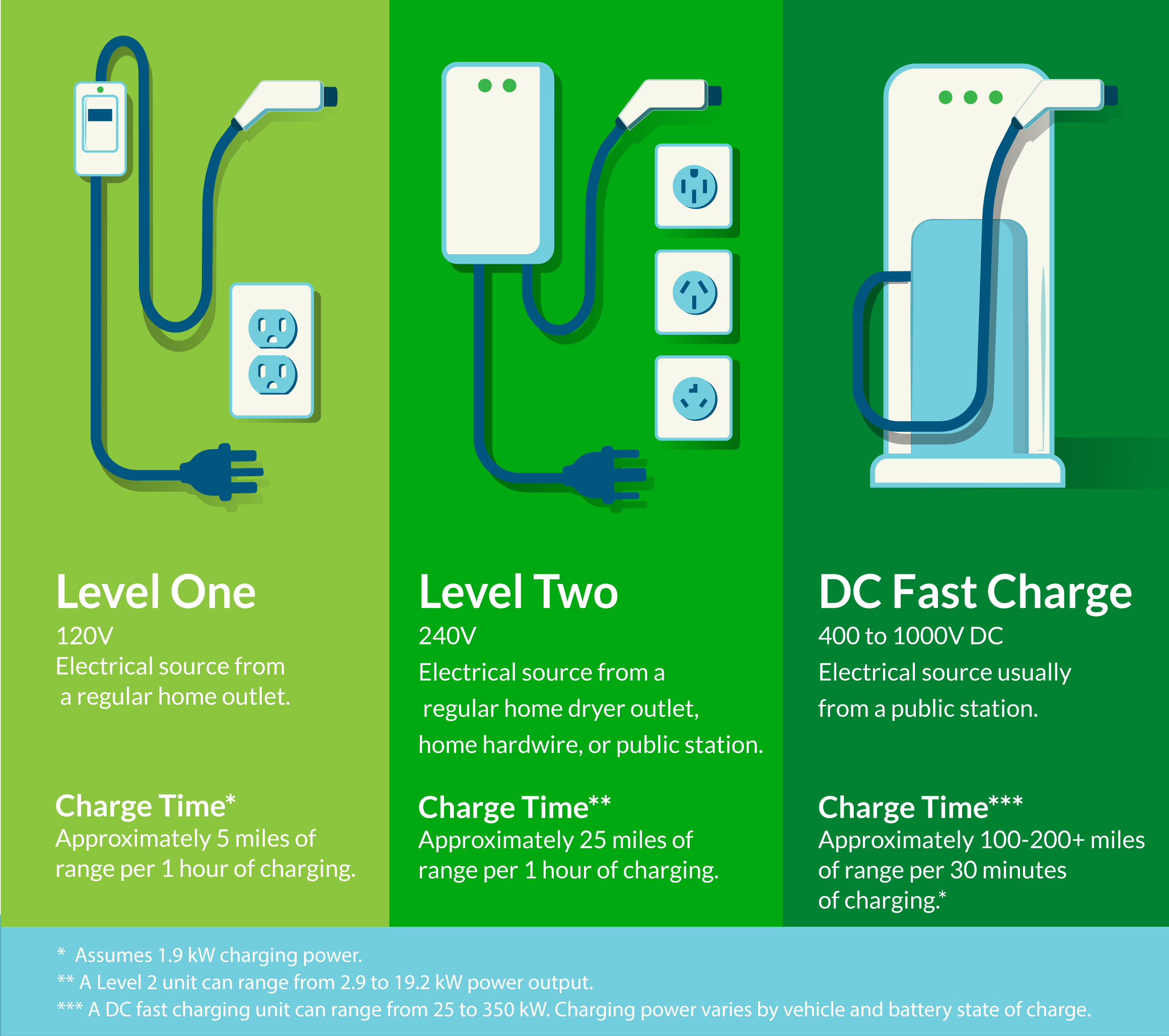
- ANSWER: EVs must plug into a charging station to refuel. There are three types of charging stations that have different charging rates and electrical needs.
- Level 1 chargers can be plugged into a standard 120-volt wall outlet. Level 1 chargers charge at the slowest rate, giving EVs two to five miles of range per hour of charging.
- Level 2 chargers require 240-volt service. Level 2 chargers give EVs 10 to 20 miles of range per hour of charging.
- Level 3 chargers, more commonly known as DC fast chargers, require three-phase 480-volt service. DC fast chargers charge at the fastest rate, giving EVs 60 to 80 miles of range per 20 minutes of charging.
When and where it is feasible, most EV drivers charge at home using Level 1 or Level 2 chargers. A growing network of public Level 2 chargers and DC fast chargers is available in the region for those who cannot charge at home. The U.S. Department of Energy’s Alternative Fueling Station Locator provides a map and listing of public EV chargers.
EVs sold in the United States can have different types of plugs. Before connecting your EV to a charger, you must ensure you are using the right plug or have an adapter. Most American- and European-made EVs use a CCS plug. Japanese-built EVs use a plug design called CHAdeMO. Most public charging stations can accommodate both. Tesla uses its own proprietary plug design and operates its own network of chargers. Tesla may be opening its charging network to non-Tesla EVs in the near future.
- EV (Electric Vehicle): A vehicle that is entirely powered by electricity.
- EREV (Extended-range electric vehicles): Vehicles that have the ability to run on a gasoline engine if the battery gets low
- HEV (Hybrid Electric Vehicles): An HEV utilizes a dual system of electric propulsion and an internal combustion engine.
- ICE: Stands for internal combustion engine, which is powered by fuel in the form of diesel or gasoline.
- Level 1 Charging: The type of charging that is usually done at home because it uses a typical 120-volt electrical outlet, charging between 8-20 amps. Level 1 charging is the slowest method and can be done with a portable charging cord.
- Level 2 Charging: These chargers are the most recommended chargers to EV owners. They may need to be professionally installed and can deliver faster charging times than Level 1 chargers, charging up to 80 amps. Portable Level 2 chargers are also available.
- Level 3 Charging, also known as DC fast charging. Offers accelerated charging away from home. This more expensive equipment is primarily available at public stations. This type of charging allows for high power transfer (>50kW) and faster recharge times (minutes instead of hours).
- PHEV (Plug-in Hybrid Electric Vehicles): PHEVs contain a battery that is able to be charged with an external electric power source, PHEV’s are a mixture of all electric vehicles and ICEV’s.
- Range: The total distance an electric vehicle can travel on one full charge before the battery needs to be recharged.
- Regenerative braking: A method of breaking used by EV in which energy from the braking of the vehicle is stored and used.
- Renewable Energy: Energy sources that naturally replenish, such as solar or wind power. When used to charge an EV, the vehicle's daily use produces no greenhouse gas emissions.